
An intelligent visualization tool that surfaces the “why” behind financial decisions, enabling families and advisors to co-create values-driven financial strategies with empathy and clarity. It provides behavioral guidance through the complexity of wealth and values.

My Role & Scope
As UI/UX Designer, I led the design vision, product ideation, and creation of the design system. I collaborated closely with teammates throughout the full project lifecycle leading user research, defining technical directions, and orchestrating iterative prototyping into a cohesive, future-ready solution.




Foundational Research & Persona Building
We began with deep research into the Cooper family scenario, mapping pain points, intergenerational dynamics, advisor involvement, and the complexities of wealth transfer. Synthesizing literature, mapping user journeys, and building rich personas (with Scott as power of attorney) ensured our design addressed authentic needs.


INITIAL SKETCHES, Wireframes, AND DESIGNS
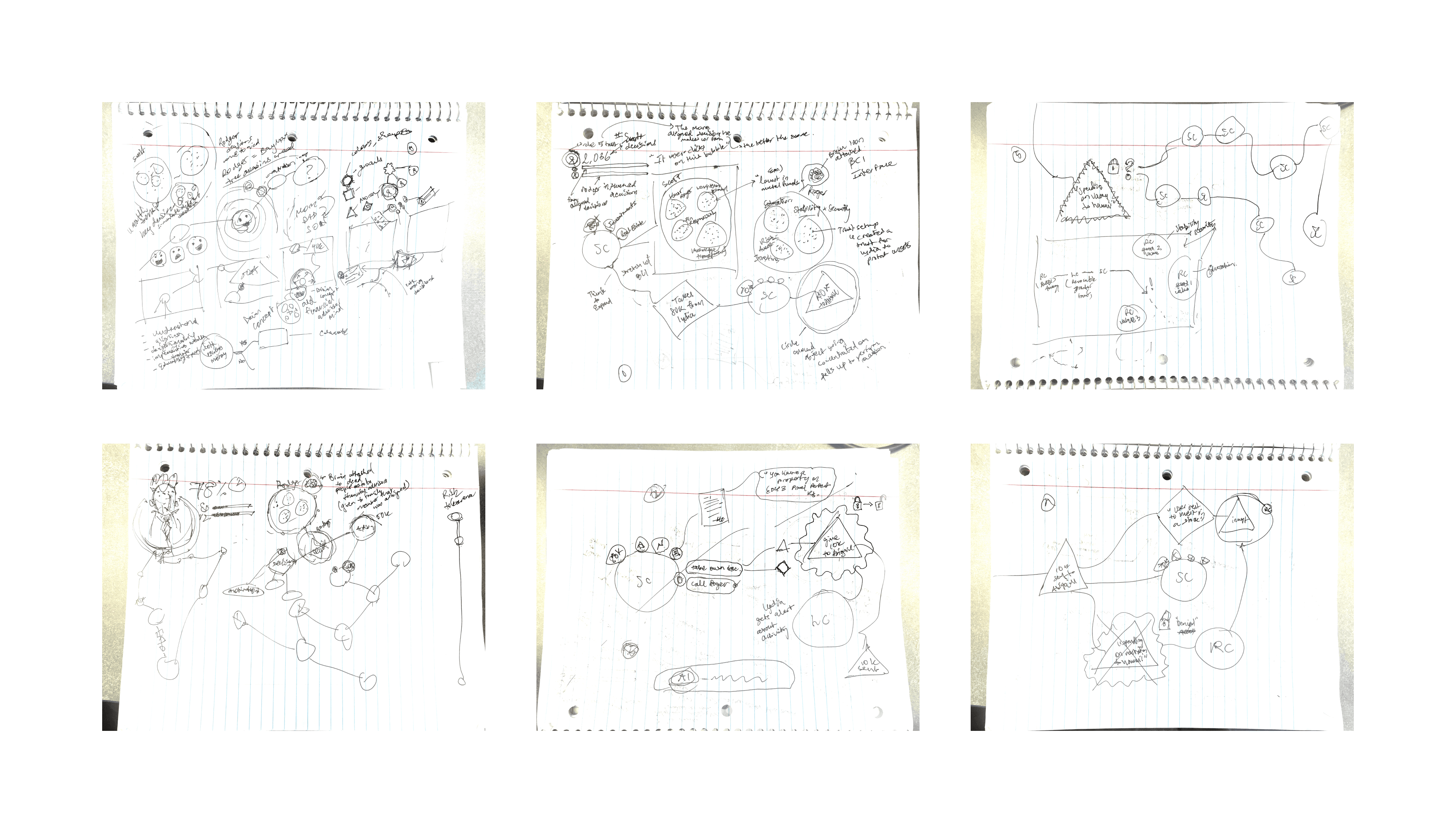
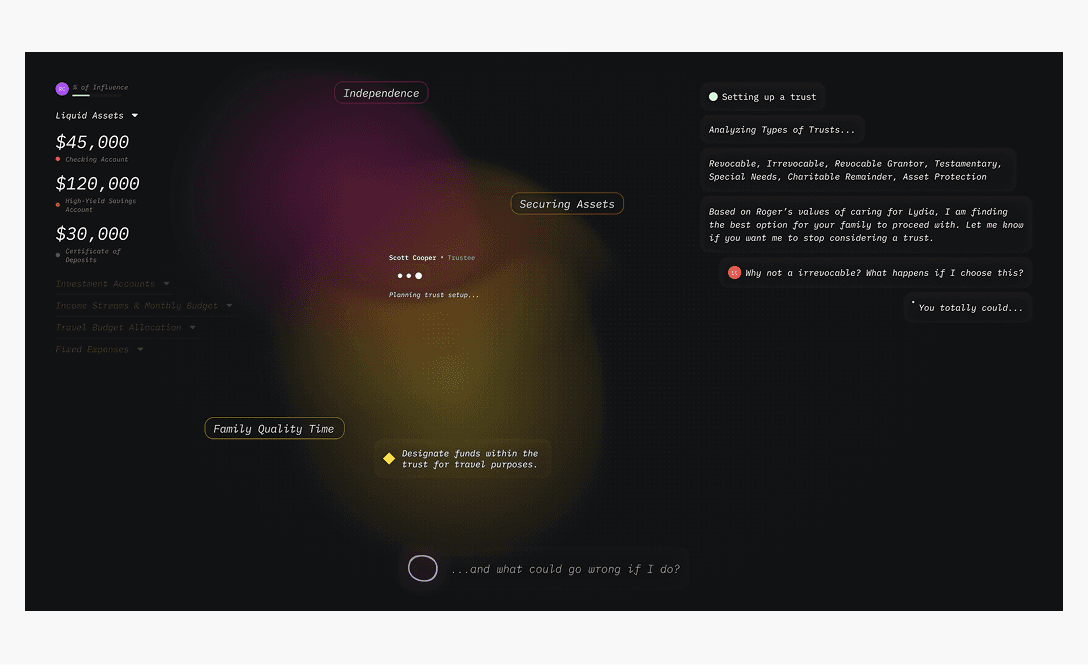
We were each experimenting with different sketches, wireframes, and designs to see if we can find a solution in the experimentation. Here are some of my concepts I've worked on:






Family System Mapping & Scenario Context
We created visual models of the extended family, clarifying everyone’s relationships and roles in decision-making. This system-level approach ensured Omnivia could facilitate collaborative planning in both in-person meetings and remote sessions, and informed our storyboards, sketches, and experience flows.

Defining and Addressing Pain Points
Our journey mapping highlighted Scott’s uncertainty about how to align decisions with family legacies, challenges of building trust with his sister and mother, and the overall stress of taking on POA roles. These findings directly shaped feature prioritization, language, and the overall tone of Omnivia.

PAIN POINTS WE SOLVED FOR
Scott lacks clarity regarding his late father’s financial intentions, making it difficult to align estate decisions with the values Roger held. Secondly, Scott struggles to incorporate his mother’s values and wishes into the financial planning of her estate.
When her husband Roger passed away, Lydia Cooper became the sole beneficiary of their assets. Her son, Scott Cooper, holds power of attorney over Lydia’s estate. Scott seeks to understand Roger’s financial intentions and ensure Lydia’s future is secure. In this scenario, Lydia and Scott meet with Ned, their Fidelity advisor, at his office.
scenario we designed for
When her husband Roger passed away, Lydia Cooper became the sole beneficiary of their assets. Her son, Scott Cooper, holds power of attorney over Lydia’s estate. Scott seeks to understand Roger’s financial intentions and ensure Lydia’s future is secure. In this scenario, Lydia and Scott meet with Ned, their Fidelity advisor, at his office.
Viability, Uniqueness, & Value
Omnivia's differentiator is its AI-powered, empathetic focused, and raises family value collaboration to the forefront of financial decisions while maintaining scalability and clear integration paths for Fidelity’s technical roadmap.
Interactive Conversational Interface
Omnivia uses voice recognition to capture live conversations. It instantly transforms key statements into interactive quote cards, which users can organize in a visual “circle of values,” surfacing common goals and highlighting differences to support open, values-driven discussion.
Collaborative Smart Table
The main interface is a digital smart table, enabling all participants: Scott, family members, and advisors, to see shared value clouds and goals in real time. Everyone also receives a personalized dashboard, ensuring individual needs are not lost within the group context.
Value Cloud Generation
The system continuously runs sentiment analysis during meetings, creating live value clouds from detected priorities and concerns. These artifacts translate abstract emotions and intentions into discussable and actionable focal points for the group.
Predictive & Context-Aware Insights
Grounded in each family’s unique priorities, Omnivia suggests next steps and forecasts the impact of key decisions, presenting recommendations as dynamic cards that can be easily prioritized or set aside empowering Scott to tackle complex trade-offs with confidence and clarity.
Legacy Lens
By referencing financial patterns and values left by Roger Cooper, the tool surfaces meaningful insights specific to Scott’s new responsibilities. This feature enables Scott to honor family intentions and draw on generational wisdom throughout estate planning.
To-Do List Phone Sync for At-Home Planning
Omnivia syncs actionable next steps to Scott’s (and his family’s) devices, making it easy to continue planning and align on priorities after a meeting, ensuring momentum is maintained beyond the smart table.
DEsign sYSTEM INTENT
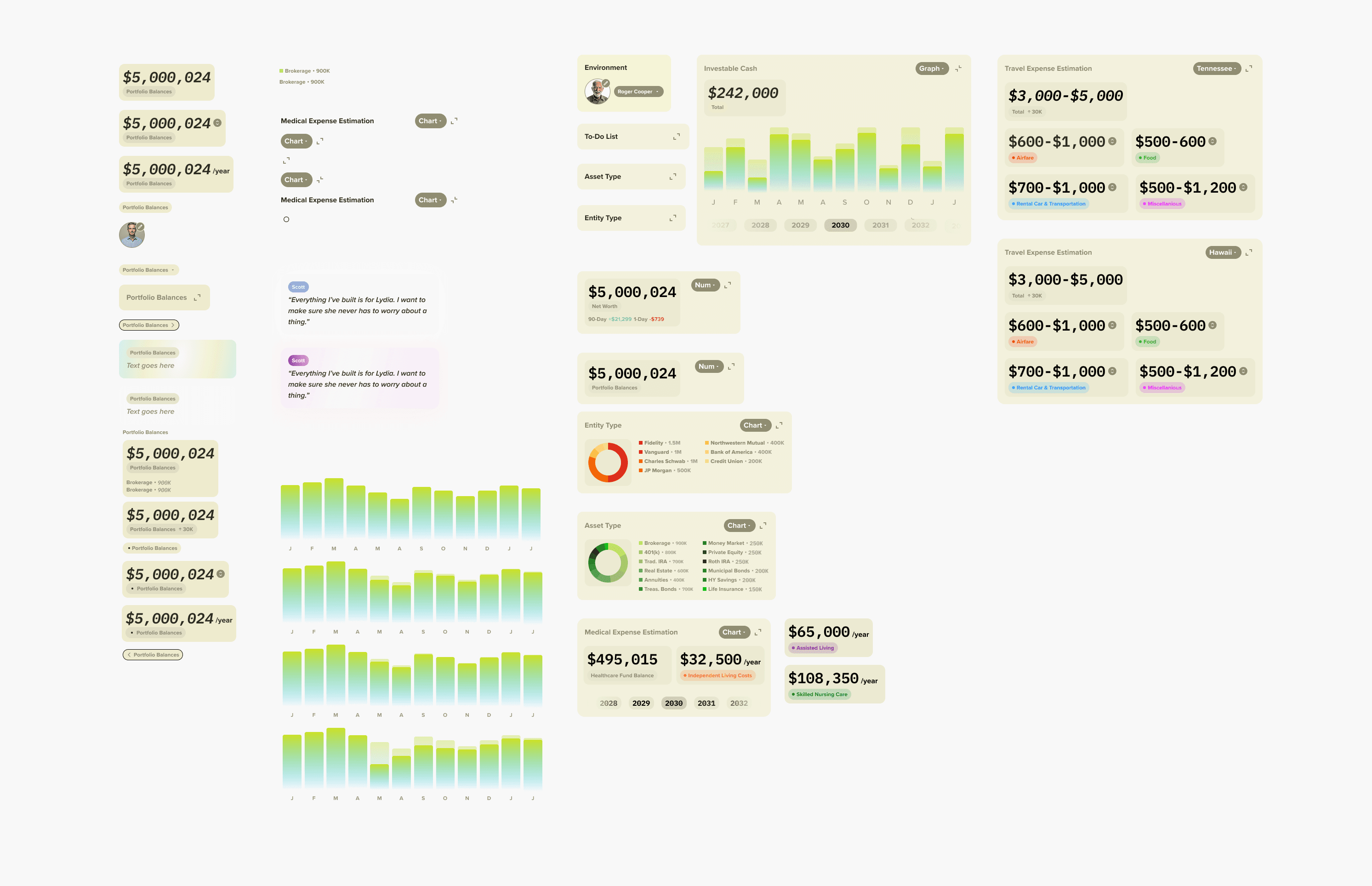
Our component-based design system prioritizes flexibility, accessibility, and multi-modal input, making it easy to scale Omnivia across platforms and add future AI/UX capabilities. Token-based color, icon, and layout standards ensure seamless integration between shared and individual views.
BENEFITS TO FIDELITY CLIENTS
Helps families align their financial decisions
with what matters most to them— not just numbers,
but life priorities.
Supports multi-generational engagement,
empowering family members to collaborate meaningfully.
Reduces anxiety by making abstract or complex financial topics tangible and thus easier to discuss.
VALUE TO FIDELITy
Deepens trust and emotional connection with clients by helping them feel seen, heard, and supported both as living and as legacy clients.
Equips Fidelity advisors with an intuitive tool to guide complex conversations and surface client values and needs more efficiently.
Legacy visualizations encourage families to remain with Fidelity as wealth passes to new generations.

Image created using ImageFX by Google
FUTURE R&D
Priority areas for continued exploration include integrating real-time emotional/biometric feedback, strengthening AI explainability for end-users, and evolving the interface to become even more immersive, ambient, and privacy-conscious as family needs and technology evolve.
How might Omnivia evolve into a multi-sensory, narrative-driven immersive financial journey
that adapts dynamically to client needs, stages
of life, and emotional states?
How might Omnivia harness behavioral finance theory to discern cognitive biases in client data in order to provide more precise recommendations?